Wednesday, 10 April 2013

Fashion Madness


Ever since “Mad Men” erupted onto our screen, it's not just been reeling in viewers, it's starting trends. The public have happily taken a sentimental voyage back to the early 1960s via the show. It's the programme that has engrossed television audiences worldwide and changed the face of fashion.

The show has been made particularly exciting by the work of costume designer Janie Bryant. In huge contrast with today’s business leaders, such as Mark Zuckerberg, who can be seen donning jeans and trainers to work, the cast of “Mad Men” are far more appealing and sophisticated. It was a time when men wore hats to work and women wore little white gloves on a daily basis. After watching an episode of the series, who wouldn’t want to live in an era of tailored suiting and gorgeous gowns? It’s easy to see why there is nostalgia for this former era.
Janie Bryant’s success in recreating the look of an advertising agency in the 1960s is the reason why so many women started to lust after 60s inspired designs.


The influence that “Mad Men” has had over today’s fashion trends is substantial. The show seems to be responsible for the obsession with floral print cinched-waist dresses, plaid capes and calf-length pencil skirts. Banana Republic released a third “Mad Men” capsule collection in March (created in collaboration with Bryant). Louis Vuitton used the tv series as inspiration to create full skirts and cleavage enhancing bodices. Some of Prada's pieces from the Spring 2012 show looked like they were just out of the series (see clip below). There were lace car coats, wool coats with nipped-in waists, pleated skirts and heirloom-like carved coral necklaces. Pointy-toe heels, tortoise shell glasses, fedoras, ladylike structured handbags are now increasingly popular and on top women’s ‘wish lists’. Clever eBay sellers are even enticing people to buy their vintage clothes by describing them as "Mad Men Style".


The most obvious example of the “Mad Men” obsession is the return of the suit. Most of the impact was understated (higher waistbands, shorter jackets), however, Michael Kor's 2008 collection was so greatly inspired by "Mad Men" that customers received a free boxset with purchases over $350.
As much as Sex and the City could be enjoyed just for the designer clothes, “Mad Men” is just as watchable for it’s charming, romantic styling.
Mad Men’s influence extends beyond the clothes, and has heralded the return of the hourglass figure. The show has helped to encourage the return of curves to both the screen and magazines. The stunningly curvaceous Christina Hendricks, who plays Joan Holloway in “Mad Men”, has been a key player in this change. She has become an icon, and along with other cast members has been seen in the likes of Vanity Fair, GQ and Vogue.

Keep the Madness coming.


Thursday, 28 March 2013

The name's Bond...


It certainly would be a struggle to find a gentleman more iconic and identifiable than James Bond. It is easy to see why we gravitate towards this timeless figure – he has the machismo of an action figure, the appeal of a spy and a flawless dress sense. While many actors have portrayed the world's most famous spy, his polished, tailored look has remained a symbol of British style. From his first appearance in Dr No, played by Sean Connery, there have been different portrayals and fashion moments, but he's always sure to be impeccably turned out.
“Of course, fashions come and go but metrosexuality isn’t a fashion – it’s an epoch. It represents a fundamental shift in what men are allowed to be and to want. Men are now permitted to be ‘passive’ – inviting our gaze.” (Mark Simpson)

From Sean Connery to Timothy Dalton, Pierce Brosnan and Daniel Craig, Bond has come a long way from what author Ian Fleming first imagined with his hounds tooth suit.

“Environmental changes are redefining what it means to be a 'man' and therefore, the phenomenon of the uninterested fashion-less male is outmoded...Generation Y males have been socialised by mass media and marketing activities to a greater extent than previous generations.” (Bakewell 2006 p170)

James Bond must be the most influential figure in menswear that doesn’t actually exist. He is not so much a fashion icon as a moving advertisement for the belief that a man can wear beautiful clothes and still be seen as masculine.

“In the evening every man looks the same. Like penguins. Women have a special dress for that event; men, the same tuxedo.” Roberto Cavalli

However when we think of James Bond, we automatically think of the tux but with Bond's extremely well tailored looks he will always stand out. Add an impressive selection of watches to the suits and you have a character with style that will constantly remain relevant. Suits are the powerful, dashing statement of the successful man.

As a style icon the character James Bond helps to showcase the best of tailoring.

The new James Bond costume designer, Lindy Hemming has reinvented Bond slightly whilst preserving his incomparable style. She has created, along with Tom Ford, a balance between modern designs and classic cuts.


Due to the amount of action in the Skyfall film, each suit had to be ordered multiple times. Tom Ford had to deliver suits, as well as shirts and ties, in duplicate for various scenes and stunt doubles. For instance, 60 duplicates of the light grey suit in the film’s opening sequence.

Each fit is impeccable and there is never a crease or hair out of place… unless he is in the center of a gun battle.


Wednesday, 6 March 2013

Black and White Life


Movies mirror society. Changing cultural norms have significantly influenced how costumes are designed and how they look on screen, as have advances in technology.  
In Black and White, silent movies, designers created visual interest chiefly through silhouette, pattern, contrast between light and dark, and reflectivity of satin, beads and sequins. Mark Bridges, costume designer for the film The Artist (2011) has said that ‘the silence was very freeing because you don’t have to worry about microphones rubbing against taffeta, and dangling jewellery’.

The silent movie era, which bore the strong influence of vaudeville and music hall, was marked by exaggerated conventions of performance. This was matched by costume design which was often intended to convey a strong archetype on first sight. Actors in silent films usually were portraying classic characters who were easily identified and defined by their clothing, hair, and makeup.  For women, this meant two main categories of characters: the virgin or the vamp. There were other types that branched from this including the flapper, the ingĂ©nue, the girl next door and the ‘It’ girl. The fashion in these silent movies helped to portray the characters to the viewers. The characters were defined by what they wore and in turn women of this era also became defined by their fashion. 

With film becoming extremely popular with the general public it meant film helped to spread fashion trends out to rural towns as well as the usual fashion forward cities, which gave everyone a taste of the new styles emerging. 

Possibly the most iconic persona of the silent movie era is ‘The Flapper’. This persona helped inspire the fashion of the twenties but still inspires fashion houses today. Actress Colleen Moore personifies this character. Her characters were entertaining, lighthearted, daring, and free-spirited, but never vampy or obscene. Her portrayals helped make the flapper accessible to the public. 

Wednesday, 27 February 2013

The Empress of Fashion

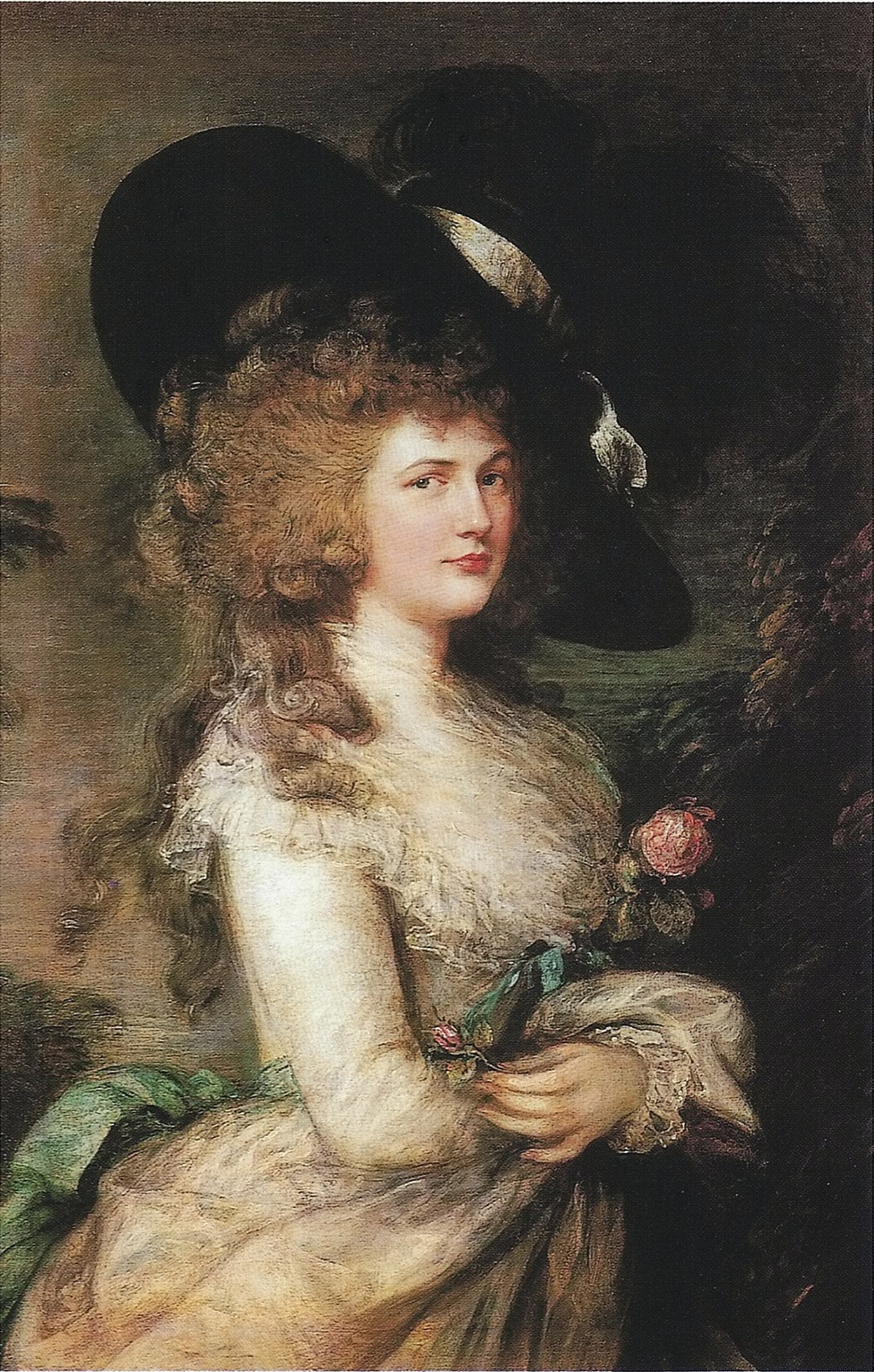
Painting by Gainsborough

Georgiana Cavendish was the 18th Century equivalent to our A list celebrities of today.  As one of the most famous personalities of her time, The Duchess of Devonshire was renowned for her beauty and incredible wardrobe.
Painting by Reynolds

Every woman in Britain, no doubt, envied Georgiana’s wardrobe. Just the Duchess' trousseau included sixty-five pairs of shoes, forty-eight pairs of stockings, and twenty-six pairs of gloves. Morning dresses, walking dresses, riding habits, ball gowns, and a presentation dress were also bought along with hats, cloaks, shawls, and wraps.

Newspapers were fascinated with the beauty and were always keeping their readers up to date on what the duchess wore:
In less than a year Georgiana had become a celebrity. Newspaper editors noticed that any report on the Duchess of Devonshire increased their sales. She brought glamour and style to a paper. A three-ring circus soon developed between newspapers who saw commercial value in her fame, ordinary readers who were fascinated by her, and Georgiana herself, who enjoyed the attention.” Amanda Foreman, historian
Georgiana made the exaggerated three-foot pompadours fashionable in London. She would stick pads of horse hair beneath her own. At one stage Georgiana's hair was so tall the only way to ride in a carriage was to sit on the floor!

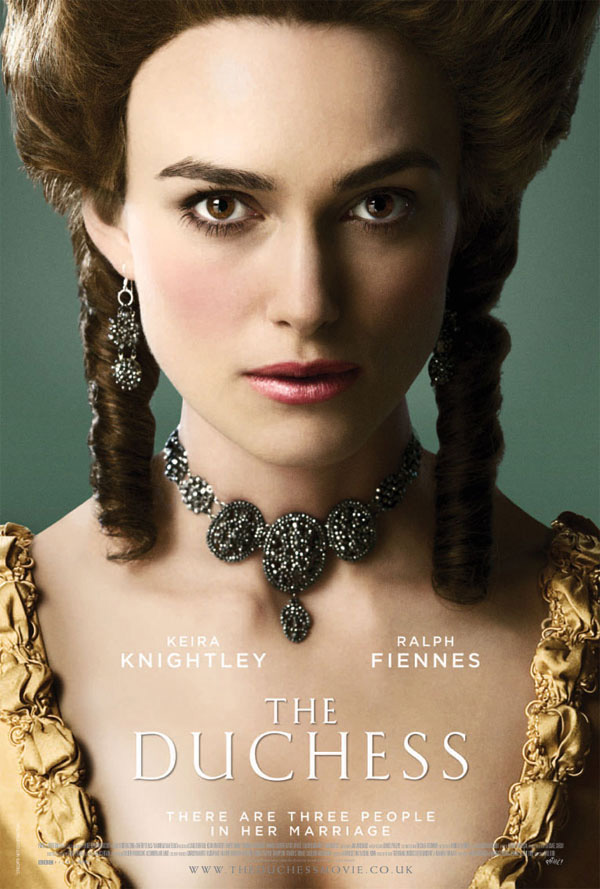
So, how apt that the 18th Century fashion icon, Georgiana Cavendish, be played by one of our very own 21st century fashion icons, Keira Knightley.


Keira Knightley as Georgiana Cavendish
The icon is stunningly illustrated in The Duchess with credit going to the magnificent costumes Michael O'Connor created for the film. O’Connor used many sources for inspiration including works of art, sketches, political pamphlets and Amanda Foreman's book, 'Georgiana, Duchess of Devonshire'.


Costumes from The Duchess
O'Connor has stated, that the dresses from that period were so intricately astounding with their great use of prints and materials, that he had to limit himself when creating costumes for the film so that they didn't steal attention away from the characters and the dialogue.